Meet Lydia
Tell me about the Bounce Back 4 Kids (BB4K) programme
The BB4K programme is a really special thing. We generally run for 8 weeks covering age-appropriate themes around domestic abuse recovery, like knowing what ‘safety’ should feel like or that children are not to blame for their experiences. All of this is done through the language that children speak best – play and creativity. We will never directly ask a child to talk about their abuse, everything is explored through story books, group activities or crafts. For example, when we explore the theme of ‘blame’ we might play a game of giant Jenga and wonder when it falls down – is that just one person’s fault or did others contribute? It helps children begin to understand that the difficult things they’ve experienced aren’t their fault. They didn’t cause the chaos around them, and they don’t need to carry the weight of that blame.
The really unique thing about BB4K is that we work with the victim-survivor parent AND the child at the same time. Literally, we’ll have the children’s group in one room and the parents’ group next door.
The beauty of this setup is the way it allows us to support both sides in real time. This means that if we’re helping children explore a feeling like anger one week, we’ll help them to understand it’s a completely natural and common emotion – one they’re absolutely allowed to feel, as long as they’re not hurting anyone with it. Meanwhile, in the parents’ group, we’re helping them understand how to support their child through that same emotion. So, all the emotional regulation and grounding tools we teach the children; the parents learn them too. That way, they can help their child practice those skills when they need them most.
What are some of the challenges the children you support face in school?
When you’ve experienced trauma like domestic abuse, whether it was directed at you or if you were just in the house where it happened, it can stay with you for a long time. It often takes years to fully process. Most people assume that once parents separate, the abuse ends. But in reality, that period can be one of the most challenging times for families, particularly children.
At school, children who’ve experienced abuse often respond in one of two ways. For some, school becomes their safe space, the one place where they can truly display their big feelings. This might show up as upset, anger or a strong need to be in control. These children are more likely to express their emotions outwardly, which can sometimes feel disruptive to teachers or classmates.
Other children may do the opposite: they internalise their emotions. These children get really good at ‘masking’ how they feel when they’re at school. And if you’re using all your energy to keep your feelings under wraps, are you really going to have the capacity to focus on multiplying fractions or learning what a verb is? These children can easily fly under the radar. Then, when they get home and they’re exhausted from holding it all in, they might have big emotional outbursts to the tiniest of triggers.
What do you find most challenging about your job?
We aim to speak to a parent within seven days of their referral to us. We work so hard to make sure everyone on our team is compassionate and friendly, a real person on the end of that phone who will take the time to understand their unique situation. That’s one of my favourite parts of the job: introducing families to what we do and hearing their excitement for the programme and how we can help them.
The tricky part is what comes next. Naturally, you want to jump straight into placing them in a group and getting started, but it’s not always that simple. Some families may have circumstances that mean we’re not the right fit just yet. For example, we can’t work with a family who is still living with their abuser, as it wouldn’t be safe or effective.
In these cases, we always do our best to refer families to services that are more suitable for their current needs, and we make sure they know they’re welcome to come back when the time is right.
What is the most rewarding?
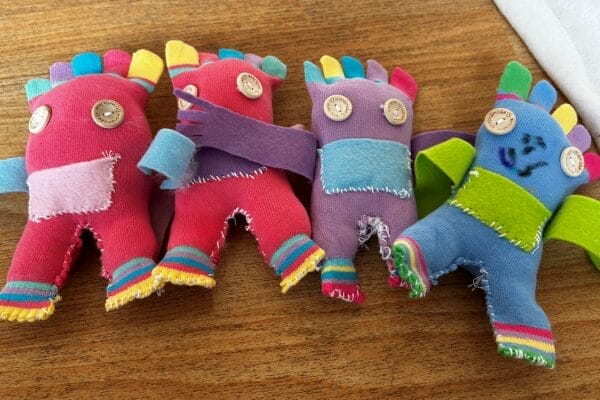
I have a huge passion for our early years age children; we work with children as young as three in our 3-5s groups. To support little ones, you have to get quite creative with how you’re going to approach a topic, especially subjects like ‘anxiety’ or ‘anger.’ We offer messy play to support mindfulness, we make ‘worry monsters’ out of sewn up toe socks and we create owl puppet families to explore separation anxiety. All different ways of using play to process and learn. It’s so much fun!
The best part is that, at the end of every 3-5s group, we bring the parents and children together for some bonding and attachment games. The activities change every week, but we always finish with a ‘blanket swing’ which is where we sing to the children as they’re swung all snuggled up in a blanket. The swinging regulates their nervous system and encourages them to feel soothed by their parent, you actually see them start to relax as they co-regulate together. So simple and so magic!